Recently the dog and I have taken to eavesdropping on the neighbor kids.
The dog gets upset and barks, but I'm fairly ambivalent about them and keep quiet. These kids aren't the cream of the crop, mind you, but they're not degenerates either. They smoke pot pretty frequently, and I've watched them drop Visine into their eyes behind their garage. They do it enough that I'd be surprised if their mom didn't know they were smoking pot and dropping Visine behind the garage.
One time I caught them smoking behind our fence. I didn't know it at the time, but they were getting high, too (the smell had wafted slowly to our yard). They looked pretty shitty: scraggily, bored, and high. I just felt bad for them. They still had the teenage acne and dopey haircuts under the hats their moms bought them from Zumiez.
I don't report them to the cops or anything; they're not hurting anyone or driving stoned. To be honest, they're not even that loud. They have a drum set in their garage, which we had growing up too but they don't really play it. Maybe they're too stoned to play. There's really nothing chill about the drums, so I guess that's out of the question. Maybe the pot works like a preventative for noise pollution. I'm not sure which would be worse. Maybe I'll go ask my neighbors from when I was a teenage Keith Moon.
I don't know if they're in high school anymore. I caught them (really just noticed them is all) behind our fence and they ran off when a girl yelled out, "Hey, Mr. Ballew!" If they aren't in school, they have friends that are. I imagine that if they are students, it will be a little awkward in the hall: I'll give them that subtle nod that says, "Hey, I know your secret Cheech, but I'm not telling," while they'll give me that acknowledging eye contact avoidance that says, "I know it's you, please don't bust me, my mom will kill me." From there on, I imagine we'll maintain the status quo.
Being a teacher doesn't actually make it more awkward in these situations; in fact, I feel it gives me a little more empathy to these High Times high schoolers. They're just kids doing what kids do: hanging out. Yeah, sure, they're doing drugs, but come on, we're a little more enlightened nowadays. They could doing coke or getting girls pregnant; instead, they're just choosing to hang out, mind their own business, and trip the light fantastic.
I say trip on, boys - as long as you stay on your side of the fence.
Reflections On A Concert: Al Green
Last week, I saw Al Green at the Tulalip Amphitheater. It was awesome. Kinda awesome. No, it was awesome. Here are some thoughts I had during the show:
1. There was a strange Native blessing before the show. It was very strange, and I felt like some of the performers didn't exactly know what they were blessing, except for one guy, which brings me to...
2. Native Americans love the beautiful ladies. They honor them. So many beautiful ladies in the world. Not the audience, but the world.
3. What is with black bass players? Why do they always have funny hats? I should ask the bass player of the opening band. His hat was funnier than Al Green's bass player's hat.
4. Black people dress up for concerts, makin' me feel like a hobo, even though I was better dressed than most people there.
5. People are willing to pay $8 for a beer, anywhere.
6. Al Green is a golden god, still.
7. Al Green only knows two cities in the northwest: Seattle and Tacoma.
8. Ladies (still) love Al Green, and judging the roses he was constantly throwing out, he loves them back.
9. Al Green is a little bit crazy. I'm not sure if it's because he's old, or because he's been a star for so long. Either way, he's kinda kooky.
10. Kooky old men are oddly likable. Kooky old women are off-putting.
1. There was a strange Native blessing before the show. It was very strange, and I felt like some of the performers didn't exactly know what they were blessing, except for one guy, which brings me to...
2. Native Americans love the beautiful ladies. They honor them. So many beautiful ladies in the world. Not the audience, but the world.
3. What is with black bass players? Why do they always have funny hats? I should ask the bass player of the opening band. His hat was funnier than Al Green's bass player's hat.
4. Black people dress up for concerts, makin' me feel like a hobo, even though I was better dressed than most people there.
5. People are willing to pay $8 for a beer, anywhere.
6. Al Green is a golden god, still.
7. Al Green only knows two cities in the northwest: Seattle and Tacoma.
8. Ladies (still) love Al Green, and judging the roses he was constantly throwing out, he loves them back.
9. Al Green is a little bit crazy. I'm not sure if it's because he's old, or because he's been a star for so long. Either way, he's kinda kooky.
10. Kooky old men are oddly likable. Kooky old women are off-putting.

Library Finds: Bottomless Bellybutton

As a child, there is only one kind of sand: sand. The beginning of Dawn Shaw's Bottomless Bellybutton explains what we come to know: there are many different kinds of sand in the world. Dry sand, wet sand, sand in the wind, sand being swept off a deck, etc..
As we grow, we accumulate experiences and knowledge. We come to know all the different kinds of sand, clouds, and water; we begin to think we have it all - life - figured out. We know what a family is, what love is, until something monumental shakes us up so bad we don't know where, or even who, we are.
The graphic novel tells the story of the Loony family and grandpa and grandma Loony's decision to separate after forty years of marriage. Each of the Loony children, Dennis, Claire, and Peter react differently to the news as they gather at the Loony family's house.
Like most families, each of the children (and their children) are different in personality, appearance, and experience. Through their reactions, we begin to understand that love is not a singularly defined thing. Like the different kinds of sand catalogued at the beginning of the story, there are different kinds of love. As children, we define romantic love by the only relationship we directly experience: the love between parents. Growing up, we experience love differently, complicating our view of love in our minds, yet often never reconcile that new definition with our parents' relationship . Bottomless Bellybutton is the story of a family individually attempting to reconcile those views, reminding us that we're never really grown up enough to know everything, we can grow up enough to accept it and maybe even appreciate it.
The graphic novel, like any good book, is alternately funny, sad, and insightful. It's also long and weighs a ton; though there are no page numbers, I would wager that it's nearly 600-700 pages long. The simplicity of Shaw's artwork and his pacing allow him to evoke complex emotions someone not familiar to the medium would think impossible from a graphic novel (I initially wrote the starkness of the artwork and narrative off myself). One three-page sequence in which a character undresses in front of another character is surprisingly sensual, while the austerity of the final pages in which the characters say goodbye to one another is devastating.
While part one (of three) may appear to be more emotional navel-gazing (pun intended) from another male with sexual and emotional hang-ups, the novel is every bit as complicated and rewarding as love. Or at least our understanding of it.
Coffee Girls
When I was in high school no one drank coffee. Teachers maybe, but certainly not students. True, we could used the caffeine kick to keep us conscious at 7:20am, but we just didn't drink it. As a result, I knew nothing about coffee and associated it with the adult world, far removed from our frivolous small town existence.
Though I may have been tempted to ignore or deny its existence, coffee was a big thing at the time. It wasn't what the cultural phenomenon it is now, or at least I don't think it was - remember, I was a teenager at the time, wont to deny the existence of that not directly in my own world. Coffee stands were around, as was Starbucks, though I only remember it from senior year onwards. You didn't order coffee at places like this, you ordered hot chocolate or whatever was seasonal or just whatever you could pronounce. As such, everything else was foreign, thus exotic to our small town minds and interests.
Men knew nothing about coffee, let alone cappuccinos or lattes; women knew about coffee, and not just any women, but exotic, cultured women. These were the kind of women (or girls, in our case) that drove Saabs, BMWs, and Mercedes cars, had trendy sunglasses, and knew where to go to dinner in Seattle. Their triple-shot caramel macciatto with skim milk was all but indecipherable to us, and further proof of their cultural superiority. If a girl knew what that drink was, she must know other drinks and where to get them, not to mention that she had the money to actually afford it. They were a stark contrast to girls we saw every day: blond highlights in a ponytail, hooded sports sweatshirt under the ubiquitous black North Face fleece, and flip flops. Always flip flops.
While some of those girls were content to just drink coffee, others made coffee. These girls were so beyond us they may as well have been exchange students, the kind who didn't need to be pretty to catch our attention (all foreign girls were inexplicably attractive to us). In school, music was our life, and a girl with credible musical taste was a rare commodity. Being a barista was the equivalent of a girl having OK Computer in her car stereo; you had to lock that girl down! The kind of girl that knew what the difference between a frappaccino and a latte - let alone how to make them - was the kind of girl who cut her hair short, wore funky clothes, and went to concerts in Seattle (the big city!). These girls were clearly out of our league.
Or at least they were in our minds.
In truth, they were likely the same over-caffeinated, over-tanned, future sorority sisters that litter high school and college campuses across the country*. Perhaps our perception of these girls was more informed by our sheltered fantasies than by actual observation. This is very plausible considering I was disappointed upon arriving in Ireland to find that no one looked like hobbits.
One thing that is undeniable is the ubiquity of coffee today. It's no longer just the city kids getting cranked up on the triple shot no foam lattes, it's everyone. Guys living in Arlington who drive who drive unnecessarily large trucks are waiting in line for their daily white chocolate mochas with whipped cream and sprinkles; those quirky, artsy girls that used to run the stands have been replaced by bikini baristas (see "future strippers"). This trend has completely demystified coffee for me. Sorry coffee girls, but I'm just not that into you anymore, but that guy in the truck might be.
Postscript:
It should be noted that the term "coffee girls" does not refer to all girls who work in the industry. No, the aforementioned ubiquity of coffee undermines this stereotype. There are a great deal of quality women - and men - who work in the egregiously massive coffee industry. To say that serving coffee is equivalent to having a butterfly tattoo on your lower back would be a humorous, albeit offensive, generalization to many women I know. If this is the case, I apologize.
*See nearly any teenage, female employee at your local mall for example(s)
Though I may have been tempted to ignore or deny its existence, coffee was a big thing at the time. It wasn't what the cultural phenomenon it is now, or at least I don't think it was - remember, I was a teenager at the time, wont to deny the existence of that not directly in my own world. Coffee stands were around, as was Starbucks, though I only remember it from senior year onwards. You didn't order coffee at places like this, you ordered hot chocolate or whatever was seasonal or just whatever you could pronounce. As such, everything else was foreign, thus exotic to our small town minds and interests.
Men knew nothing about coffee, let alone cappuccinos or lattes; women knew about coffee, and not just any women, but exotic, cultured women. These were the kind of women (or girls, in our case) that drove Saabs, BMWs, and Mercedes cars, had trendy sunglasses, and knew where to go to dinner in Seattle. Their triple-shot caramel macciatto with skim milk was all but indecipherable to us, and further proof of their cultural superiority. If a girl knew what that drink was, she must know other drinks and where to get them, not to mention that she had the money to actually afford it. They were a stark contrast to girls we saw every day: blond highlights in a ponytail, hooded sports sweatshirt under the ubiquitous black North Face fleece, and flip flops. Always flip flops.
While some of those girls were content to just drink coffee, others made coffee. These girls were so beyond us they may as well have been exchange students, the kind who didn't need to be pretty to catch our attention (all foreign girls were inexplicably attractive to us). In school, music was our life, and a girl with credible musical taste was a rare commodity. Being a barista was the equivalent of a girl having OK Computer in her car stereo; you had to lock that girl down! The kind of girl that knew what the difference between a frappaccino and a latte - let alone how to make them - was the kind of girl who cut her hair short, wore funky clothes, and went to concerts in Seattle (the big city!). These girls were clearly out of our league.
Or at least they were in our minds.
In truth, they were likely the same over-caffeinated, over-tanned, future sorority sisters that litter high school and college campuses across the country*. Perhaps our perception of these girls was more informed by our sheltered fantasies than by actual observation. This is very plausible considering I was disappointed upon arriving in Ireland to find that no one looked like hobbits.
One thing that is undeniable is the ubiquity of coffee today. It's no longer just the city kids getting cranked up on the triple shot no foam lattes, it's everyone. Guys living in Arlington who drive who drive unnecessarily large trucks are waiting in line for their daily white chocolate mochas with whipped cream and sprinkles; those quirky, artsy girls that used to run the stands have been replaced by bikini baristas (see "future strippers"). This trend has completely demystified coffee for me. Sorry coffee girls, but I'm just not that into you anymore, but that guy in the truck might be.
Postscript:
It should be noted that the term "coffee girls" does not refer to all girls who work in the industry. No, the aforementioned ubiquity of coffee undermines this stereotype. There are a great deal of quality women - and men - who work in the egregiously massive coffee industry. To say that serving coffee is equivalent to having a butterfly tattoo on your lower back would be a humorous, albeit offensive, generalization to many women I know. If this is the case, I apologize.
*See nearly any teenage, female employee at your local mall for example(s)
Library Finds: Graphic Novelfest 2009 Pt. I
It's graphic novelfest 2009 at 114 N Dunham Ave this summer. Here are our recommendations:
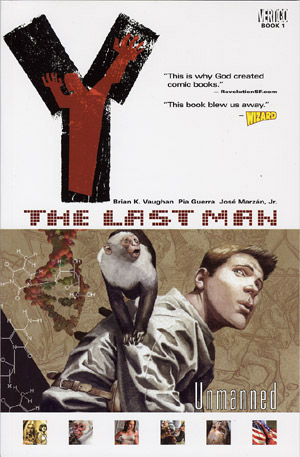
Read Brian K. Vaughan's Y: The Last Man series now before it blows up as a movie trilogy and pop culture milestone. It's epic in the greatest sense of the word: long, intricate, funny, philosophical, and heartbreaking. It's Lord of the Rings if it only focused on Frodo's journey and instead of Sam, Frodo had a pet monkey named Ampersand. Also, instead of Orcs, there are ninja assassins and militant feministas. The narrative is tightly focused considering the length and depth of the multiple plot lines; though some subplots seem arbitrary. they useful ways for Vaughan to explore the implications of a world without the Y chromosome. It's an achievement of imagination, and reading it has been as much of a rewarding experience as I've had reading any other "traditional" novel. It is to my 20s what Star Wars was to my early teens: a flawed masterpiece that is a lens through which I now view everything else.

When you're done reading Y, you'll want to read everything else Vaughan has written, and I would recommend Ex Machina, the series directly following Y. EM follows Mitch Hundred, a normal guy who comes across an alien (?) artifact which endows him with the ability to talk to and control machines. He becomes a super hero (like the Rocketeer, really), saves the second plane from hitting the World Trade Towers, becomes a celebrity, then decides he can make a greater difference by running for mayor of New York. The story follows his tenure as mayor, and feels like an amalgam of West Wing, Superman, and The Wire. Like Y, the dialogue is smart, fast, and full of pop-culture references. It's also fantastic, too.

The Escapists, also by Vaughan, is a shorter series that is as tightly written as either of the mentioned series. It's an homage to the comics medium itself. The art is a bit cartoon-y, but the writing is flawless.

The only writer that rivals Vaughan in my book is Grant Morrison. Morrison's run on X-Men was brilliant (do check it out), and his take on Superman is transcendent. All-Star Superman Vol. I & II concern the twilight of Supe's life, exploring the themes of power and responsibility better than anything I've ever read. The writing is simple, beautiful, poetry almost. And the end, it's just heart-wrenching to turn each page. It's almost a shame they have to continue publishing Superman comics after this series, because it would be the perfect swan song to the series' long history. Attention movie studios, drop all the terrible ideas and scripts you have now and pick up this series, but please don't change a thing. It's perfect. PERFECT.
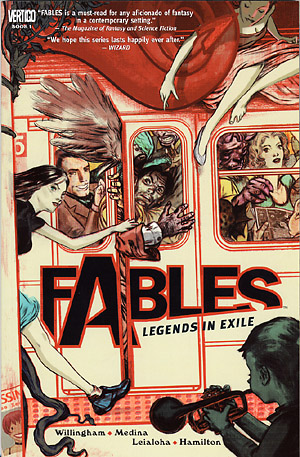
Bill Willingham's Fables is also decent. Imagine all the fairytale creatures and characters in the modern world, forced to conceal themselves in a small community in New Jersey after being forced out of their lands. It's fun to observe and speculate what kinds of modern problems these old characters find themselves in (Snow White divorces Prince Charming, the Beast turns back into a beast every time he and Beauty fight, and who wouldn't after hundreds of years?). There's not much to invest in as a reader so far, but I'm only on vol. II.
Pt. II of the recommendation list will tackle the more alternative comic-style graphic novels.
Read Brian K. Vaughan's Y: The Last Man series now before it blows up as a movie trilogy and pop culture milestone. It's epic in the greatest sense of the word: long, intricate, funny, philosophical, and heartbreaking. It's Lord of the Rings if it only focused on Frodo's journey and instead of Sam, Frodo had a pet monkey named Ampersand. Also, instead of Orcs, there are ninja assassins and militant feministas. The narrative is tightly focused considering the length and depth of the multiple plot lines; though some subplots seem arbitrary. they useful ways for Vaughan to explore the implications of a world without the Y chromosome. It's an achievement of imagination, and reading it has been as much of a rewarding experience as I've had reading any other "traditional" novel. It is to my 20s what Star Wars was to my early teens: a flawed masterpiece that is a lens through which I now view everything else.
When you're done reading Y, you'll want to read everything else Vaughan has written, and I would recommend Ex Machina, the series directly following Y. EM follows Mitch Hundred, a normal guy who comes across an alien (?) artifact which endows him with the ability to talk to and control machines. He becomes a super hero (like the Rocketeer, really), saves the second plane from hitting the World Trade Towers, becomes a celebrity, then decides he can make a greater difference by running for mayor of New York. The story follows his tenure as mayor, and feels like an amalgam of West Wing, Superman, and The Wire. Like Y, the dialogue is smart, fast, and full of pop-culture references. It's also fantastic, too.
The Escapists, also by Vaughan, is a shorter series that is as tightly written as either of the mentioned series. It's an homage to the comics medium itself. The art is a bit cartoon-y, but the writing is flawless.
The only writer that rivals Vaughan in my book is Grant Morrison. Morrison's run on X-Men was brilliant (do check it out), and his take on Superman is transcendent. All-Star Superman Vol. I & II concern the twilight of Supe's life, exploring the themes of power and responsibility better than anything I've ever read. The writing is simple, beautiful, poetry almost. And the end, it's just heart-wrenching to turn each page. It's almost a shame they have to continue publishing Superman comics after this series, because it would be the perfect swan song to the series' long history. Attention movie studios, drop all the terrible ideas and scripts you have now and pick up this series, but please don't change a thing. It's perfect. PERFECT.
Bill Willingham's Fables is also decent. Imagine all the fairytale creatures and characters in the modern world, forced to conceal themselves in a small community in New Jersey after being forced out of their lands. It's fun to observe and speculate what kinds of modern problems these old characters find themselves in (Snow White divorces Prince Charming, the Beast turns back into a beast every time he and Beauty fight, and who wouldn't after hundreds of years?). There's not much to invest in as a reader so far, but I'm only on vol. II.
Pt. II of the recommendation list will tackle the more alternative comic-style graphic novels.
FCB
Of course they're going to be good, but I didn't know they'd be that good. Barcelona is amazing. Truly something to behold. And let's be honest, they probably weren't even playing that hard. Did you see Henry, he just smiled and let those botched shots and runs slide off his back like a duck's feathers.
Really, though, this game was all about Messi. I had heard of this kid (22 years old!) before, but wow, did he live up to the hype. Unbelievable. And did anyone else notice a startling resemblance to a young Dustin Hoffman? Even the hair, which, come on Lionel, with all that money surely you can get something more up to date than Al Pacino's hair style in Scarface?

+

=

Really, though, this game was all about Messi. I had heard of this kid (22 years old!) before, but wow, did he live up to the hype. Unbelievable. And did anyone else notice a startling resemblance to a young Dustin Hoffman? Even the hair, which, come on Lionel, with all that money surely you can get something more up to date than Al Pacino's hair style in Scarface?
+
=
Weddings: The Ultimate Social Event
Why is it that weddings get such a bad rap? So many people look down upon them, but then have their own wedding. Why bother if you dislike them so much? Some men might toss off the obligatory, "Well, she wanted one, so you know," but I hear plenty of women complaining about weddings. I understand it's a necessary cultural ritual and rite of passage, but what's so bad about a wedding? Really?
I love weddings.
Let's get that out there first and foremost, because it's about to get all biased up in here.
Reasons why weddings are awesome:
1. Weird family members
They don't even need to be your own to get a kick out of someone's uncle Ralphy
2. Free drinks
Even if it's just beer and wine, you can get as many as you want w/out even getting out your wallet or feeling like you've got a problem, because, hey, it's a celebration. Right?
3. Appetizers
Yes, they're usually more bland and cold than a restaurant appetizer, but they taste that much better after your third glass of wine.
4. Toasts
Most of the time they're terrible, which is often more entertaining. The cliches and awkward fight to stave off the tears make the drink afterwards that much better.
5, Dancing
Wedding dancing is like public school; it's an idiosyncratic culture and event where giving either a half-assed, off-the-cuff effort or an intense, over-the-top effort are completely acceptable (everything in the middle is derided). Even better, though, is the mixture of reasons #1 and #2. Watching your wined-up grandma or uncle dance to Daft Punk or the Jackson 5 makes you want to get down even more and do those ridiculous dance moves you would never do in any other public situation. Golden.
6. Desserts
It used to be the obligatory cake, but now people are starting to break away from tradition for novelty. Cupcakes, pies, dessert trays. These aren't your ordinary cupcakes, either, these are creme brulee with turkish sea salt caramel icing. Even if it is just a cake, it's better than a Costco cake. Let them have cake!
I know of very few other events that adhere to every item on this list - political conventions, perhaps - making them the ultimate social event. I can't wait to go to another wedding.
Excuse me, could I have another glass of the white? Thank you!
I love weddings.
Let's get that out there first and foremost, because it's about to get all biased up in here.
Reasons why weddings are awesome:
1. Weird family members
They don't even need to be your own to get a kick out of someone's uncle Ralphy
2. Free drinks
Even if it's just beer and wine, you can get as many as you want w/out even getting out your wallet or feeling like you've got a problem, because, hey, it's a celebration. Right?
3. Appetizers
Yes, they're usually more bland and cold than a restaurant appetizer, but they taste that much better after your third glass of wine.
4. Toasts
Most of the time they're terrible, which is often more entertaining. The cliches and awkward fight to stave off the tears make the drink afterwards that much better.
5, Dancing
Wedding dancing is like public school; it's an idiosyncratic culture and event where giving either a half-assed, off-the-cuff effort or an intense, over-the-top effort are completely acceptable (everything in the middle is derided). Even better, though, is the mixture of reasons #1 and #2. Watching your wined-up grandma or uncle dance to Daft Punk or the Jackson 5 makes you want to get down even more and do those ridiculous dance moves you would never do in any other public situation. Golden.
6. Desserts
It used to be the obligatory cake, but now people are starting to break away from tradition for novelty. Cupcakes, pies, dessert trays. These aren't your ordinary cupcakes, either, these are creme brulee with turkish sea salt caramel icing. Even if it is just a cake, it's better than a Costco cake. Let them have cake!
I know of very few other events that adhere to every item on this list - political conventions, perhaps - making them the ultimate social event. I can't wait to go to another wedding.
Excuse me, could I have another glass of the white? Thank you!
Subscribe to:
Comments (Atom)